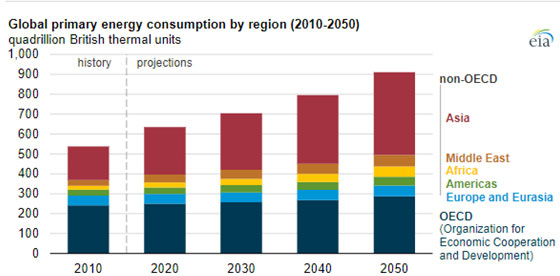
The energy consumption in 2050 will be very different today. Meeting future energy demand with affordable cost will be a key challenge. The world’s population will increase from approximately 9.4 billion in the Symphony scenario in 2050, energy consumption will grow by nearly 50% till 2050. Most of this growth comes from developing countries like India where growth is focused in regions where strong economic growth is driving demand. As per EIA data it clearly indicates that the industrial sector is a major contributor in energy usage by 2050, global industrial energy consumption reaches about 315 quadrillion British thermal units (Btu).

Error! Filename not specified.
Let’s Study worldwide energy consumption
Source: https://www.eia.gov/todayinenergy/detail.php?id=41433
In this unprecedented time where uncertainty for the energy demands has continued to increase, we need to understand pressure, consequences and challenge in the energy sector.
Though there are numerous energy conservation awareness campaigns targeting consumer’s senses trying to make everybody conscious of the significance of conserving energy and protecting the environment but it hardly affecting the core users. Repercussions of access energy use every day damaging the earth. An increase in carbon footprint is the biggest result of using too much energy is an increase, which refers to the amount of carbon dioxide and all its other compounds emitted into the air. Which results in obvious further nature damage, we know it as climate change. Global responsibility is one part but users are not even concerned about the fact that how much they are spending for untracked energy usage . If people continue to misuse energy, sooner or later, we will run out of supply. The little bit that we get would be very expensive. You will feel anxiety after your electricity bills.
Globally, brick and mortar structures are responsible for approximately 40% of the total world yearly energy consumption. As per Accenture Report, The retail industry, business offices ingests energy across primary categories: stores, distribution centers, offices etc. The physical retail , locations or office space account for a large percentage of a energy consumption. In a typical 50,000 square foot retail building, a retailer’s lighting and heating, ventilation and air conditioning alone account for 75 % of total energy use. In some retail supercentres and grocery stores, consumption analyses can vary due to refrigeration & air-condition systems, which act as another major electricity user. It is also vital to note that, although 50,000 square feet represents average retail store size, “big-box” and electronic retailers often build stores in excess of 100,000 square feet, further increasing both energy consumption and costs. On average, a retail store in a developed economy consumes 14.3 kWh per square foot and spends approximately $1.47 per square foot on energy, depending on the price of energy.
Nowadays business owners, executive level heads, decision makers are focusing on this crucial parameter as well. They sense immense need to reduce their overheads by saving energy as well.