Time-lapse solutions are a valuable tool in many industries, but they are perhaps best known for their ability to compress time. By capturing images at fixed intervals and combining hundreds or even thousands of frames into a single video, time-lapse technology allows viewers to watch hours, days, or even months of activity unfold in just a few minutes.
The technique gets its name from its ability to make time appear to move much faster than it actually does. From documenting construction projects and observing celestial movements to recording the growth of plants or the progress of major sporting events, time-lapse provides a unique perspective that standard video recording cannot achieve.
A time-lapse sequence is created by taking photographs at predetermined intervals using a camera equipped with an intervalometer, a device that automatically triggers the camera shutter at regular time increments. Once compiled, these images create a smooth video that clearly illustrates gradual changes over time.
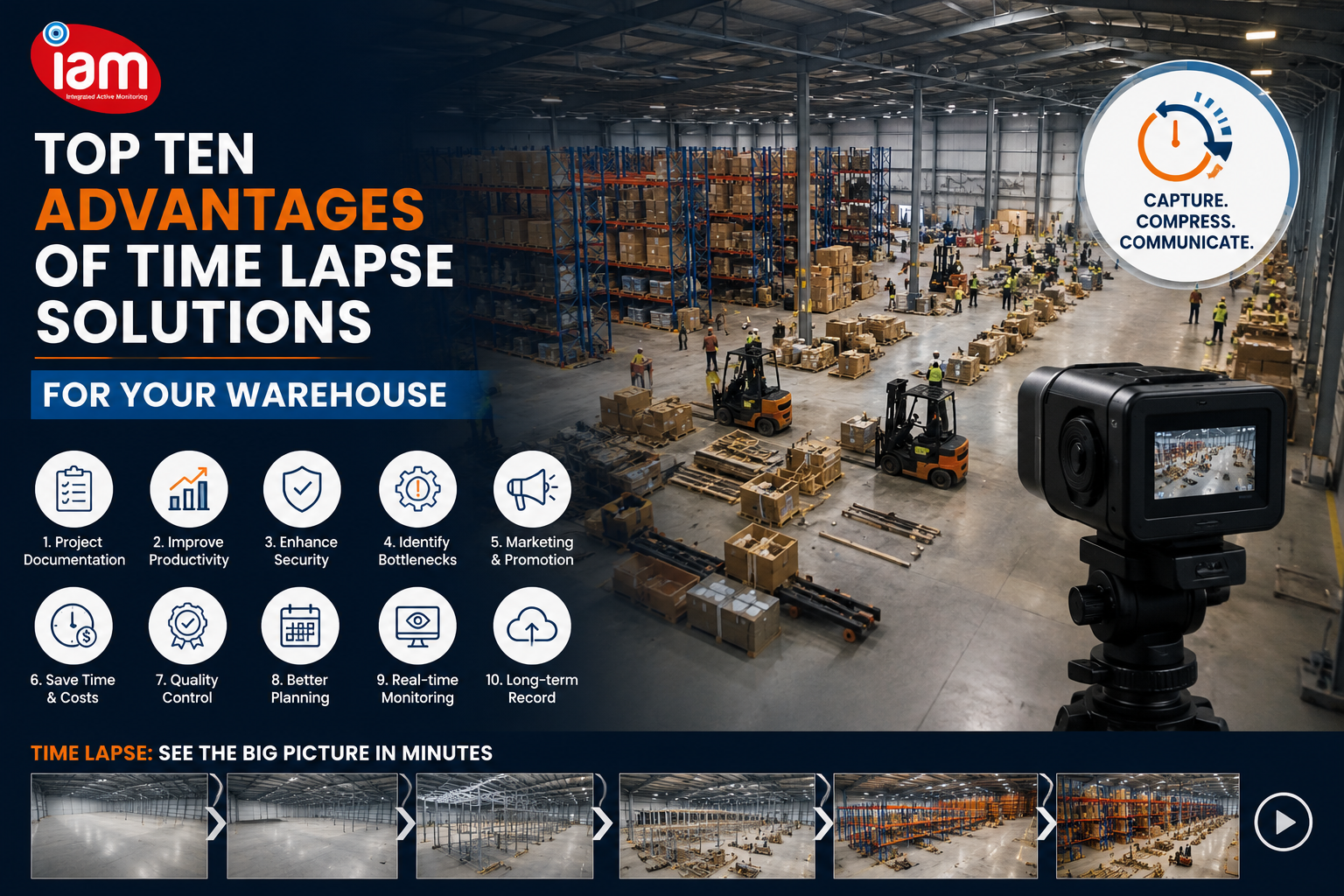
In warehouse environments, where operations, construction projects, equipment installations, and inventory movements often occur over extended periods, time-lapse solutions offer an efficient way to document progress and gain valuable operational insights. Here are the top ten advantages of using time-lapse solutions in your warehouse.
1. Efficient Project Documentation
Warehouse construction, facility expansion, and equipment installations can take weeks or months to complete. Time-lapse solutions provide a complete visual record of the project from beginning to end, making it easy to review milestones and maintain accurate documentation for future reference.
2. Simplified Progress Monitoring
Instead of reviewing hours of continuous video footage, managers can quickly watch a short time-lapse video to understand how a project or operation has progressed. This saves time while providing a clear overview of daily, weekly, or monthly developments.
3. Better Workflow Analysis
Time-lapse recordings provide a broader perspective of warehouse activities. By reviewing operations over an extended period, businesses can identify bottlenecks, congested areas, inefficient workflows, or unnecessary movement, helping improve overall productivity.
4. Improved Space Utilization
Warehouse layouts often evolve as inventory levels and operational requirements change. Time-lapse footage helps visualize how storage areas, loading zones, and workspaces are being used, enabling managers to optimize available space and improve operational efficiency.
5. Enhanced Project Communication
Time-lapse videos provide an easy and engaging way to communicate project progress with stakeholders, contractors, management teams, or clients. Instead of relying solely on written reports or static images, a short visual summary clearly demonstrates the work completed over time.
6. Support for Process Improvement
Continuous improvement begins with understanding how operations are performed. Reviewing time-lapse recordings allows warehouse managers to observe repetitive tasks, identify delays, and evaluate operational changes, helping teams make informed decisions to improve efficiency.
7. Improved Safety Awareness
Although time-lapse solutions are not designed to replace real-time surveillance systems, they can provide valuable insights into warehouse activity patterns. Reviewing footage can help identify recurring safety concerns, traffic flow issues, or areas where additional safety measures may be beneficial.
8. Valuable Training Resource
Time-lapse videos can serve as effective training materials for new employees by demonstrating warehouse layouts, equipment installations, operational procedures, or project timelines. Visual learning often makes complex processes easier to understand and remember.
9. Cost-Effective Historical Record
Maintaining a visual history of warehouse projects can be valuable for future planning, maintenance, audits, and facility management. Time-lapse solutions create concise records that are significantly easier to store, review, and present than large volumes of continuous video footage.
10. Professional Visual Presentation
Time-lapse videos create engaging visual content that can be used for project presentations, internal reports, investor updates, marketing materials, or social media. Watching an entire warehouse project unfold in a matter of minutes provides an impressive way to showcase progress and achievements.
Common Applications of Time-Lapse Solutions in Warehouses
Time-lapse technology is widely used across warehouse and industrial environments for various applications, including:
- Warehouse construction and expansion
- Storage rack installation
- Equipment commissioning
- Inventory reorganization
- Loading dock improvements
- Facility maintenance projects
- Automation system installation
- Seasonal warehouse reconfiguration
- Production line setup
- Long-term renovation projects
Conclusion
Time-lapse solutions are much more than a creative way to record video. They provide warehouse operators with an efficient method for documenting projects, monitoring progress, analyzing workflows, and communicating developments in a simple and visually compelling format. By compressing extended periods into short, informative videos, time-lapse technology makes it easier to understand how warehouse operations evolve over time.
As warehouses continue to focus on efficiency, optimization, and continuous improvement, time-lapse solutions offer a practical way to capture valuable insights while creating a permanent visual record of important projects and operational changes.
1.What is a time-lapse solution?
A time-lapse solution captures images at predefined intervals and combines them into a video sequence, allowing long-duration events to be viewed in a much shorter time. It is commonly used to document projects, monitor progress, and visualize gradual changes.
2. How are time-lapse solutions used in warehouses?
Time-lapse solutions are used to document warehouse construction, equipment installation, inventory reorganization, facility expansion, maintenance projects, and workflow improvements. They provide a clear visual record of activities over extended periods.
3.Can time-lapse cameras replace CCTV systems?
No. Time-lapse cameras and CCTV systems serve different purposes. CCTV provides continuous real-time surveillance for security, while time-lapse cameras capture images at intervals to create condensed videos for project documentation and progress monitoring.
4.What are the benefits of using time-lapse technology for warehouse projects?
Time-lapse technology helps simplify project documentation, monitor construction progress, improve communication with stakeholders, analyze workflows, create training material, and maintain a visual history of warehouse operations
5.Which industries commonly use time-lapse solutions?
Time-lapse solutions are widely used in warehousing, logistics, construction, manufacturing, infrastructure development, retail, agriculture, mining, and industrial facilities where long-term projects or operational changes need to be documented efficiently.