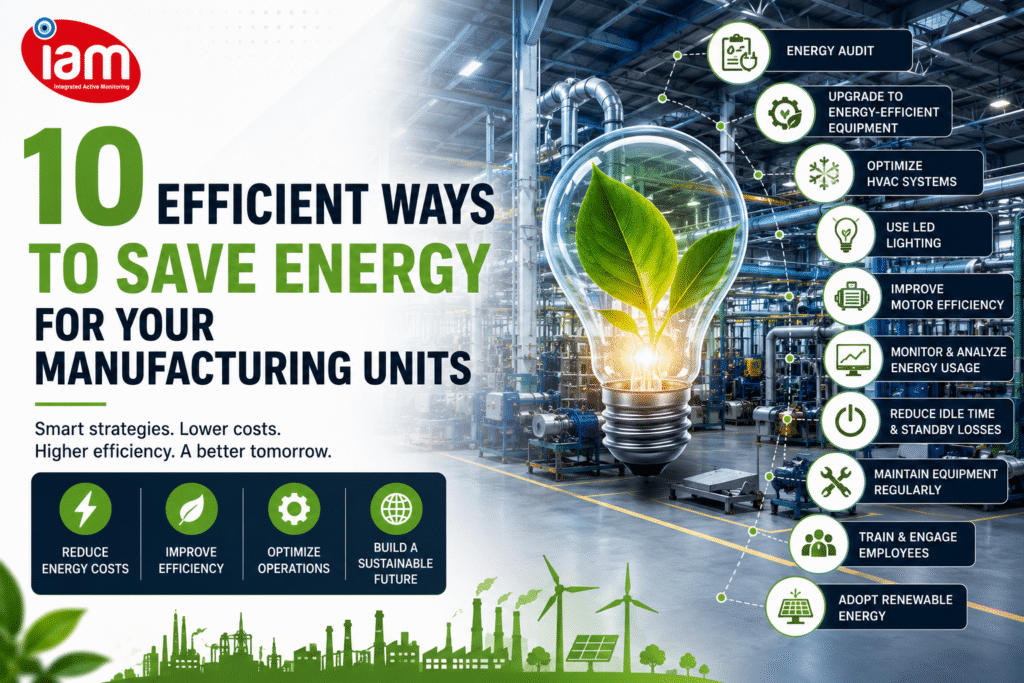
10 Efficient Ways to Save Energy in Your Manufacturing Unit
Industry is the single largest consumer of electricity in India, accounting for roughly 41.8% of national consumption — ahead of households, agriculture and commercial use. For most plants, power is the second or third biggest controllable cost after raw material and labour.
The uncomfortable part: in a typical factory, 10–20% of that power is simply wasted. Air leaks. Motors idling against throttled valves. Lights burning over empty bays. HVAC fighting an open shutter. None of it appears on a P&L labelled “waste” — it just appears as a bigger bill.
The cheapest unit of energy is the one you never consume. Here’s where to find it.
1. Submeter before you strategise
A single plant-level meter tells you what you spent, not where. Device-level meters on compressors, chillers, ovens and production lines convert a lump-sum bill into an itemised one. Every other step on this list depends on this one.
2. Hunt down compressed air leaks
Compressed air is the costliest utility on most shop floors — and the leakiest. Run your compressor during a planned shutdown. If it’s still cycling load/unload with zero production, you’re paying to pressurise the atmosphere.
3. Fit VFDs to the right motors
Motors dominate factory load. Pumps and fans running at fixed speed against a throttled valve waste power by design. Variable frequency drives match motor speed to actual demand.
4. Kill your idle load
Check consumption at 3 a.m. on a Sunday. Whatever that figure is, it is your baseline waste — standby machines, unloaded compressors, exhaust fans, corridor lighting.
5. Manage maximum demand and power factor
Demand charges and low-power-factor penalties inflate bills silently. Staggering the start-up of heavy loads and correcting power factor often pays for itself within months.
6. Shift non-critical loads to off-peak hours
Where Time-of-Day tariffs apply, moving batch processes, charging and heavy pumping out of peak windows reduces cost without reducing output.
7. Upgrade lighting to LED with occupancy sensing
The fastest win available. LEDs paired with daylight and motion sensors in warehouses, corridors and QC bays cut lighting load sharply with a short payback.
8. Recover your waste heat
Flue gas, compressor heat and boiler blowdown all carry usable energy. Recover it to preheat feedwater or process water instead of venting it.
9. Link maintenance to energy data
A motor drawing more current for the same output is telling you a bearing is failing. Rising kWh-per-unit-produced is an early maintenance alarm, not just a cost signal.
10. Make energy intensity a shop-floor KPI
Track kWh per tonne or per piece, per shift. Publish it. Give supervisors a target. Frameworks like BEE’s PAT scheme and ISO 50001 provide the structure — but the number has to be visible daily to change behaviour.
How Smart IAM helps you act on all ten
Nine of these ten steps rest on one prerequisite: knowing exactly where every unit of energy goes, as it goes.
That is what our IoT-based Energy Monitoring System is built for. Smart meters and sensors are installed across your critical equipment — machinery, compressors, HVAC, lighting, generators and UPS systems. The IAM Gateway streams that data to a cloud dashboard you can open from a plant office or a phone.
You get device-level load profiles, historical trend analysis across multiple plants, automated alerts the moment a spike or anomaly appears, and generator runtime and fuel-efficiency tracking. Manufacturers using the system typically achieve up to 20% energy savings and a measurable reduction in carbon footprint.
Because it runs on the same platform as our manufacturing surveillance, fire and RFID solutions, energy sits in the same command centre as safety and operations — not in a separate spreadsheet.
Ready to see where your plant’s energy actually goes? Talk to the Smart IAM team for a walkthrough of the dashboard.
FAQs
How much can a factory realistically save on energy?
Most plants find 10–20% savings without buying new machinery — the gains come from eliminating idle load, leaks and demand penalties that were never visible.
What’s the fastest energy saving to implement?
Fixing compressed air leaks and switching to LED with occupancy sensors. Both are low-capex with paybacks usually inside a year.
Do I need to replace my existing meters?
No. Smart IAM’s sensors and gateway layer on top of existing infrastructure and push data to a single cloud dashboard.