Retail Footfall Counter and Its Benefits
Every visitor who walks into your store represents an opportunity. Yet many businesses only measure the final outcome—a sale—without understanding how many people entered, when they visited, or why some left without making a purchase.
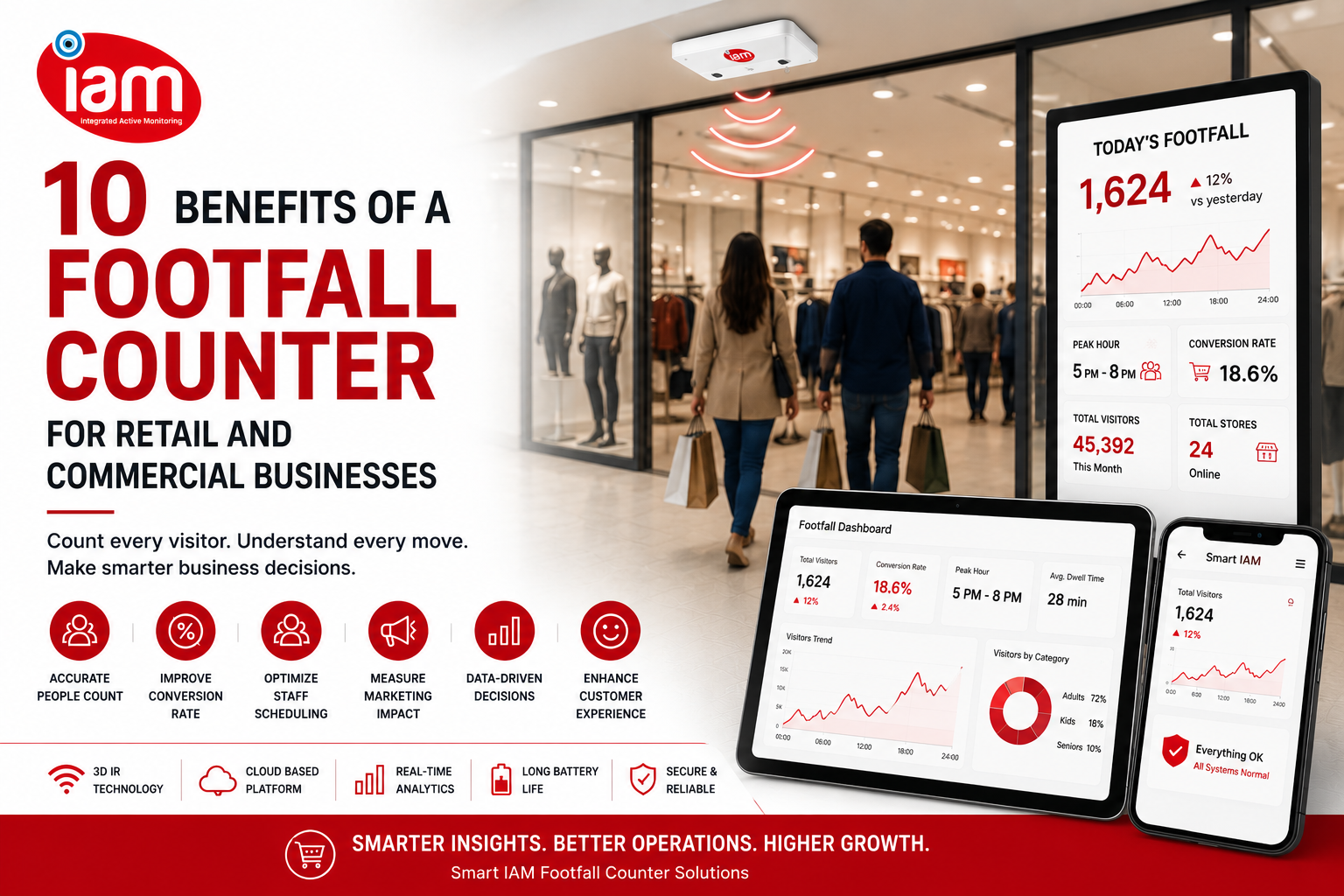
A footfall counter helps bridge that gap by providing accurate visitor data that businesses can use to improve operations, marketing, staffing, and customer experience. Modern solutions, such as Smart IAM’s People Counting Solution, go beyond simple visitor counting by combining 3D IR technology, IoT-based reporting, and real-time analytics to help businesses make informed decisions.
Whether you manage a retail store, supermarket, shopping mall, bank, hospital, or commercial building, understanding visitor behaviour is the first step toward improving business performance.
Know how many customers actually visit your business
Sales figures only tell part of the story. A footfall counter records every visitor entering your premises, giving you a clear picture of customer traffic throughout the day.
Instead of relying on estimates, businesses can identify:
- Daily visitor count
- Peak shopping hours
- Weekly and monthly traffic trends
- Seasonal customer behaviour
These insights provide the foundation for better operational planning and business growth.
Measure your conversion rate
One of the biggest benefits of using a footfall counter is understanding your store’s conversion rate.
For example, if 1,000 visitors enter your store and 150 complete a purchase, your conversion rate is 15%.
This simple metric helps retailers determine whether sales issues are caused by low visitor traffic or by poor in-store conversion. Combined with sales data, visitor analytics provide a much clearer picture of store performance than revenue alone.
Businesses implementing Smart IAM’s People Counting Solution can use visitor data to support better retail decision-making across single and multi-store operations.
Improve staff scheduling
Customer traffic rarely remains consistent throughout the day. Some stores experience heavy traffic during lunch hours, while others become busier in the evenings or on weekends.
Accurate footfall data allows businesses to schedule staff based on actual visitor demand rather than assumptions. This improves customer service during busy periods while reducing unnecessary labour costs during quieter hours.
Businesses looking to modernise store operations often combine visitor analytics with Smart IAM’s Retail Automation Solutions to improve efficiency across multiple retail processes.
Measure the success of marketing campaigns
Every marketing campaign should produce measurable results.
Whether you’re running festive promotions, newspaper advertisements, digital campaigns, or local events, a footfall counter helps determine whether those efforts actually increased visitor traffic.
Instead of asking whether a campaign was successful, businesses can compare visitor numbers before, during, and after each promotion to understand its real impact.
This allows marketing budgets to be allocated based on performance rather than assumptions.
Improve customer experience
Long queues, overcrowded entrances, and insufficient staffing can negatively affect the shopping experience.
Visitor analytics help businesses identify peak shopping periods so they can prepare accordingly by opening additional billing counters, assigning more staff, and improving customer flow.
Retailers that invest in intelligent store technologies often combine people counting with Smart IAM’s Retail Solutions to improve both operational efficiency and customer satisfaction.
Optimise store layout
Footfall data reveals more than visitor numbers—it helps businesses understand shopping patterns.
Retailers can compare customer traffic before and after changing store layouts, promotional displays, or product placements to determine what attracts more visitors.
Over time, this data supports better merchandising decisions, improved product visibility, and more effective use of retail space.
Compare multiple stores from one dashboard
Businesses operating multiple locations need more than individual store reports.
Modern footfall counting systems provide centralised dashboards that allow managers to compare visitor traffic across different branches.
This helps identify:
- High-performing stores
- Peak shopping hours by location
- Marketing performance
- Store productivity
- Long-term traffic trends
Smart IAM’s People Counting Solution enables businesses to monitor visitor analytics across multiple locations through an IoT-enabled reporting platform.
Make data-driven business decisions
Business decisions become more reliable when supported by accurate data.
Historical visitor analytics help businesses forecast seasonal demand, plan expansion strategies, optimise operating hours, and improve resource allocation.
Instead of relying on intuition, managers can make informed decisions based on measurable customer behaviour.
Improve operational efficiency
Today’s footfall counters are no longer standalone devices that simply count visitors.
Modern solutions integrate visitor counting with business analytics, allowing retailers to monitor customer traffic, evaluate marketing performance, and improve overall store operations.
Smart IAM’s RealCount solution uses 3D IR technology to deliver highly accurate visitor counting while providing businesses with real-time insights through its IoT-based reporting platform.
Gain a competitive advantage
Retail is increasingly driven by data.
Businesses that understand visitor behaviour can respond more quickly to changing customer preferences, improve conversion rates, optimise staffing, and evaluate marketing performance with greater confidence.
A reliable footfall counter gives businesses the visibility needed to make continuous improvements rather than reacting after opportunities have already been lost.
As customer expectations continue to evolve, visitor analytics will remain an essential part of modern retail operations.
Final Thoughts
A footfall counter does far more than count the number of people entering your premises. It provides valuable insights into customer behaviour, conversion rates, staffing requirements, marketing effectiveness, and overall business performance.
For businesses looking to adopt data-driven retail operations, Smart IAM’s People Counting Solution combines 3D IR technology, IoT-enabled reporting, and real-time analytics to help organisations make better operational decisions across single and multi-location businesses.