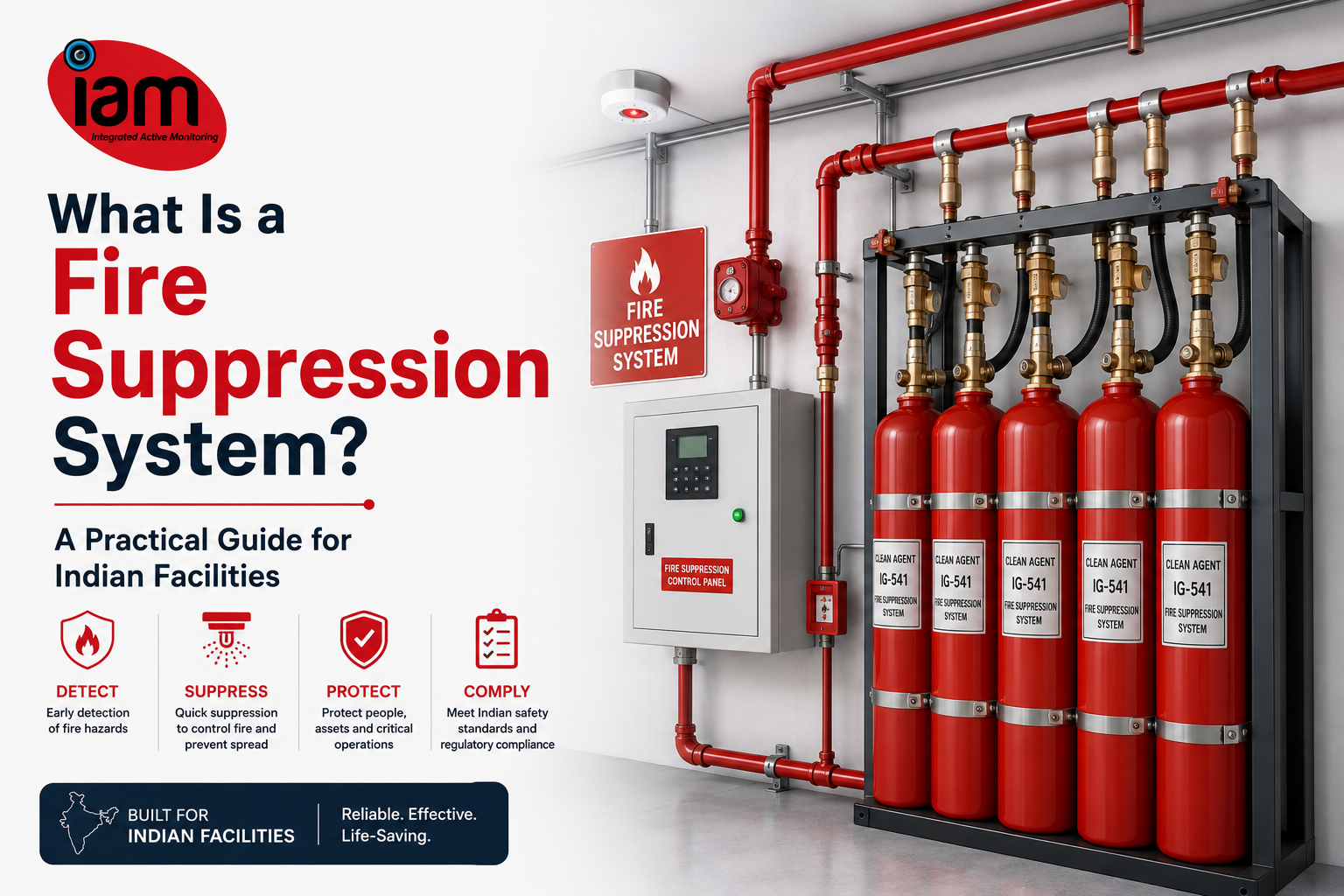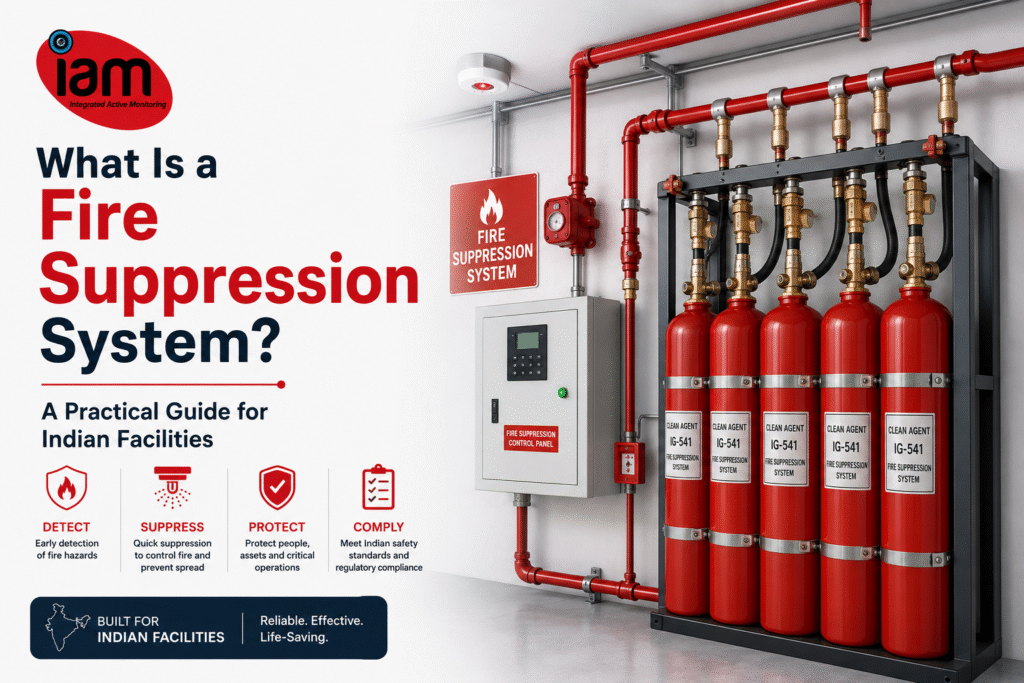
A fire suppression system is the part of your fire safety setup that actually puts the fire out. Detection tells you something is burning; suppression stops it. That distinction sounds obvious, but it’s where most facility owners go wrong they install smoke detectors and a hooter, assume they’re covered, and discover during an audit that they have no way to control a fire once it starts.
Suppression is the active response. A detector or sensor identifies heat, smoke, or flame, and the system releases an agent — water, gas, foam, or powder — to cool the fire, cut off its oxygen, or interrupt the chemical reaction that keeps it burning. In most commercial and industrial installations this happens automatically, without waiting for a person to pull a lever.
This guide covers what these systems are, the main types in use, and how to work out which one your facility actually needs. If you already know you need a system and want to talk specification, our fire suppression systems page has the deployment detail. If you’re still at the “how do we even know there’s a fire” stage, start with fire detection systems, because suppression is only as good as the detection that triggers it.
How a fire suppression system works
Every system, whatever the agent, follows the same three-step logic: detect, trigger, discharge.
Detection comes from the alarm side — smoke detectors, heat detectors, air-sampling units, or flame sensors wired to a control panel. When the panel confirms a genuine event (good systems require confirmation from more than one sensor to avoid discharging on a false alarm), it triggers the release. The suppression agent then floods the protected space or sprays directly onto the hazard.
What changes between systems is the agent and the method. A sprinkler drops water on a fire to cool it below its ignition point. A clean-agent system floods a sealed room with gas that absorbs heat and interrupts combustion. A CO₂ system displaces the oxygen the fire needs to survive. The right choice depends entirely on what you’re protecting and what would happen if you used the wrong agent on it — water on a live electrical panel or a server rack causes damage that can cost more than the fire would have.
The main types of fire suppression system
Water-based systems
The most common and most cost-effective category, suitable for offices, retail floors, warehouses, and most general commercial space. This family includes several sprinkler configurations that suit different conditions:
Wet pipe sprinklers keep water in the pipes at all times for the fastest response, and work anywhere the building stays above freezing. Dry pipe sprinklers hold air in the pipes instead, releasing water only when a head activates, which makes them right for unheated areas like parking structures and cold warehouses. Pre-action systems add a second trigger condition before water is released, which is why data centres, libraries, and archives use them — an accidental knock to a sprinkler head won’t soak the equipment. Deluge systems open every head at once for high-hazard areas such as aircraft hangars and power plants.
Water mist deserves a separate mention. Instead of a heavy drench, it discharges ultra-fine droplets that cool the fire and displace some oxygen while wetting far less of the surrounding area, which suits hospitals, museums, and other places where water damage is a real cost.
Clean agent and gaseous systems
These suppress fire without water and leave no residue, which makes them the standard choice for server rooms, IT infrastructure, control rooms, and anywhere the contents are worth more than the building. Two agents dominate.
FK-5-1-12, sold for years under the brand name Novec 1230, is a fluid stored as a liquid that discharges as a gas. Its appeal is environmental and practical at once: a global warming potential of 1, an atmospheric lifetime of roughly five days, zero ozone depletion, and a safety margin that allows use in occupied spaces (its no-observable-adverse-effect level is 10%). Under NFPA 2001, the international standard for clean agent systems, these systems must reach design concentration within about ten seconds — fast enough to suppress a fire in its early stage before it damages equipment.
FM-200 (HFC-227ea) is the older workhorse and still protects a huge installed base, but it carries a global warming potential of around 2,250, and HFC production is being phased down globally. New installations increasingly specify FK-5-1-12 or inert gas blends instead. Inert gas systems (nitrogen, argon, or blends like IG-541) work differently again, lowering the oxygen in a room to around 12% — below what a fire needs but survivable for people during evacuation.
A caution on CO₂ systems: they’re highly effective at smothering fires in electrical rooms and around flammable liquids, but they suppress by removing oxygen, which makes them dangerous in occupied areas. They belong in normally unmanned spaces, and they fall under a separate standard (NFPA 12) rather than the clean-agent one.
Specialised hazard systems
Some risks defeat both water and gas. Foam systems smother flammable liquids and stop them re-igniting, which is why fuel depots and chemical plants use them. Dry chemical systems throw a fast-acting powder that handles solid, liquid, and gas fires, common in industrial spray booths and around vehicle engines. These are targeted solutions for a specific hazard, not general-purpose cover.
Portable fire extinguishers
Not a system exactly, but your first line of defence and a legal requirement in nearly every Indian building. The key is matching the extinguisher to the fire class. Class A covers ordinary solids like wood and paper. Class B is flammable liquids. Class C is flammable gases. Class F is cooking oils and fats — the reason commercial kitchens need wet chemical extinguishers specifically, since water or foam on a hot oil fire makes it worse. Electrical fires aren’t a separate class but a condition: they need a non-conductive agent such as CO₂ or a clean agent, never water.
How to choose: the fire really does dictate the system
There’s a reason a good supplier assesses your site before quoting rather than selling you a standard package. A fire in a data centre and a fire in a chemical plant are different problems, and the wrong agent creates a second disaster on top of the first — water ruins servers, CO₂ endangers staff, and a sprinkler in a fuel store spreads burning liquid instead of stopping it.
The practical way to approach it is by asking three questions about each area of your facility. What’s the dominant fuel — solids, liquids, electronics, cooking media? Is the space occupied when a fire is likely? And what does collateral damage from the suppression agent itself cost you? Answer those honestly, zone by zone, and the right combination usually becomes clear. A single building often needs sprinklers in the general areas, a clean agent in the server room, and wet chemical in the canteen kitchen.
This is also where sector experience matters. Facilities in warehousing, healthcare, and manufacturing each carry characteristic risks, and a supplier who has worked in your sector will spot the ones a generic checklist misses.
The gap most systems have: nobody’s watching the panel
Here’s the failure mode that doesn’t show up in a brochure. A suppression system is only as reliable as the panel that triggers it, and panels fail quietly. A fault light comes on in an unmanned plant room, a battery degrades, a zone gets isolated during maintenance and never re-enabled. The system looks armed. It isn’t. You find out during the fire.
This is the case for connecting fire systems to centralised, round-the-clock monitoring rather than relying on a local hooter that only helps if someone happens to be standing nearby. Cloud-connected panels report their own health continuously, escalate a real alarm instantly to whoever needs to act, and flag faults before they become the reason a system didn’t fire. For businesses running multiple sites, this is the difference between knowing the status of every location from one screen and hoping each site’s panel is fine. Smart IAM’s centralised monitoring system is built for exactly this — turning a set of independent local systems into one supervised network.
Where Indian regulation fits in
None of this is optional. Fire and life safety in India is governed by Part 4 of the National Building Code 2016, published by the Bureau of Indian Standards. It sorts every building into one of nine occupancy groups (A to I, running from residential through educational, institutional, business, mercantile, industrial, storage and hazardous), and your group determines almost everything downstream: the fire rating of the structure, exit widths, whether sprinklers are mandatory, and refuge requirements. Buildings of 15 metres and above count as high-rise and carry stricter provisions again.
The practical consequence is that your suppression design isn’t just an engineering decision, it’s a compliance one. Getting the occupancy classification and the corresponding fire protection wrong surfaces at the fire NOC stage, where it’s expensive to retrofit. It’s far cheaper to design the right system in than to be told to rebuild it after the fact.
A fire suppression system isn’t a single product you buy off a shelf. It’s a set of decisions about what you’re protecting, what could go wrong, and who finds out when it does. Get those right, zone by zone, and the equipment follows. Get them wrong and you own an expensive false sense of security. If you want a facility assessment that starts from your actual risks rather than a catalogue, that’s the conversation worth having next.