What Role Utilization And Occupancy Monitoring For Your Workspaces Plays In Post Covid Environment ?
A few years ago, the pandemic did something no facilities manager had ever managed to do: it forced every organization to look hard at how its office space was actually being used. Buildings that had run at assumed-full capacity for decades suddenly sat empty, and companies discovered they had almost no real data on their own workspaces — only floor plans and assumptions.
That reckoning didn’t end when offices reopened. It evolved into something more permanent. With hybrid work now the default rather than the exception, the question is no longer “is everyone in?” but “how much of this space do we actually need, and how is it really being used?” And you cannot answer that with a badge count and a guess. This is where workspace utilization and occupancy monitoring have moved from a nice-to-have to a genuine business tool.
What occupancy monitoring actually measures
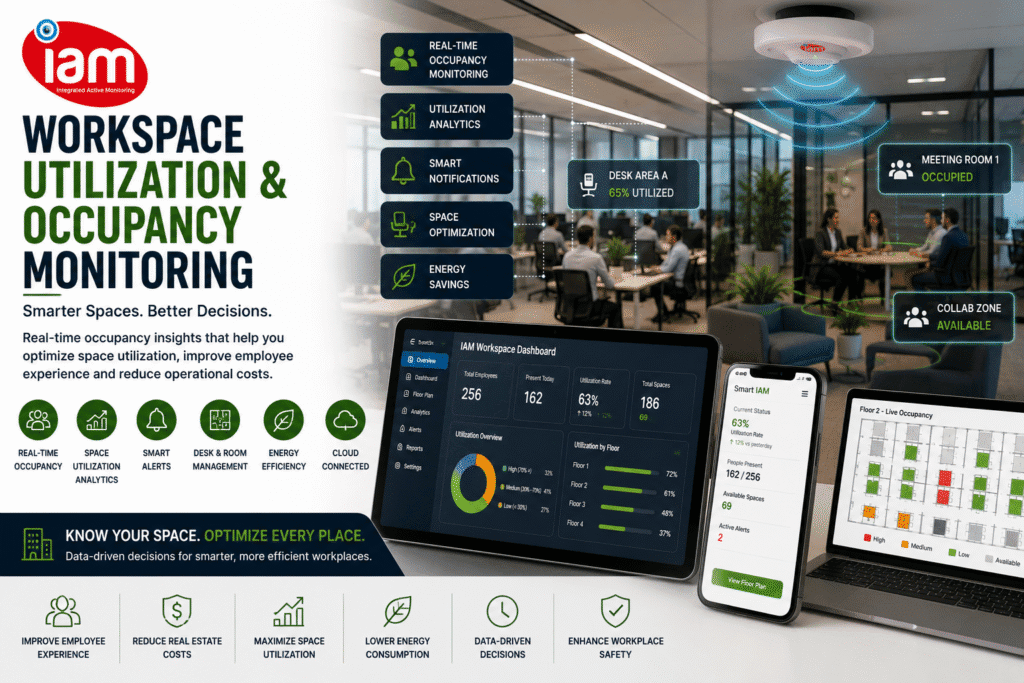
Occupancy monitoring is the practice of measuring how, when, and by whom your spaces are used — not just the building as a whole, but desks, meeting rooms, cafeterias, and common areas individually.
Instead of assumptions, you get real-time data: how many people are present, in which zones, at what times of day and days of the week. Sensors and people-counting devices capture the flow, cloud software turns it into live dashboards, and facilities managers can see the maximum, minimum, average, and peak usage of every space they manage. What was invisible — the actual rhythm of how a workplace breathes through a week — becomes a measurable, analyzable picture.
Smart IAM approaches this the same way it approaches the rest of the building: as connected, IoT-driven intelligence. The people-counting technology behind occupancy monitoring feeds the same kind of real-time dashboard that runs across the wider centralized monitoring system, so space data sits alongside security, energy, and environment in one view rather than in a silo.
Why utilization data matters now
The value of this data breaks down into a few concrete wins.
Right-sizing real estate. Office space is one of the largest fixed costs a business carries. When you can see that a floor runs at 40% utilization on a Monday and 15% on a Friday, or that half the meeting rooms are never booked while the rest overflow, you can make decisions worth real money — consolidating floors, redesigning layouts, or sub-letting space you were paying for and not using.
Designing for how people actually work. Hybrid teams don’t use an office the way a fixed 9-to-5 workforce did. Utilization data shows which spaces people gravitate to, which sit idle, and where the friction is — so you design around real behavior instead of a decade-old assumption about desks-per-head.
Smarter resource use. Occupancy data doesn’t just inform property decisions; it drives the building itself. Knowing how many people are in a given zone lets you match cooling, lighting, and ventilation to actual presence rather than running full systems over empty floors. That ties workspace monitoring directly to energy efficiency — you consume resources where people are, and stop wasting them where they aren’t.
Health, comfort, and capacity. The lessons the pandemic taught about density didn’t disappear — they became good facilities practice. Real-time occupancy still helps manage comfortable density in shared areas, maintain healthy air and conditions, and keep spaces within sensible capacity, all of which feed employee wellbeing and productivity.
From counting people to understanding space
The shift worth appreciating is that this technology graduated. The same people-counting and analytics tools that were originally built to study customer footfall for retail marketing turned out to be exactly what workplaces needed to understand themselves.
It’s the same core capability behind retail footfall and heat-mapping analytics — count the people, map where they go, study how long they stay — pointed at a new question. In a store, that data tells you where customers linger and buy. In an office, it tells you which spaces earn their cost and which don’t. The measurement is the same; the decision it informs is different.
That’s the broader logic of the IoT-based monitoring approach at Smart IAM: one set of sensing and analytics capabilities, applied across security, energy, environment, and now space itself, all reporting into a single connected system.
Space is a cost you can finally manage
For most of corporate history, office space was a fixed assumption — you signed the lease, filled the floors, and rarely questioned it. Utilization and occupancy monitoring turns that assumption into a managed variable. You see exactly how your space performs, cut what you don’t need, design around how people actually work, and run the building itself more efficiently in the process.
In a hybrid world, the organizations that win the real-estate question are the ones measuring it. The rest are still guessing.
Want to see how your workspace is really being used? Talk to Smart IAM about occupancy and utilization monitoring.