What is RFID
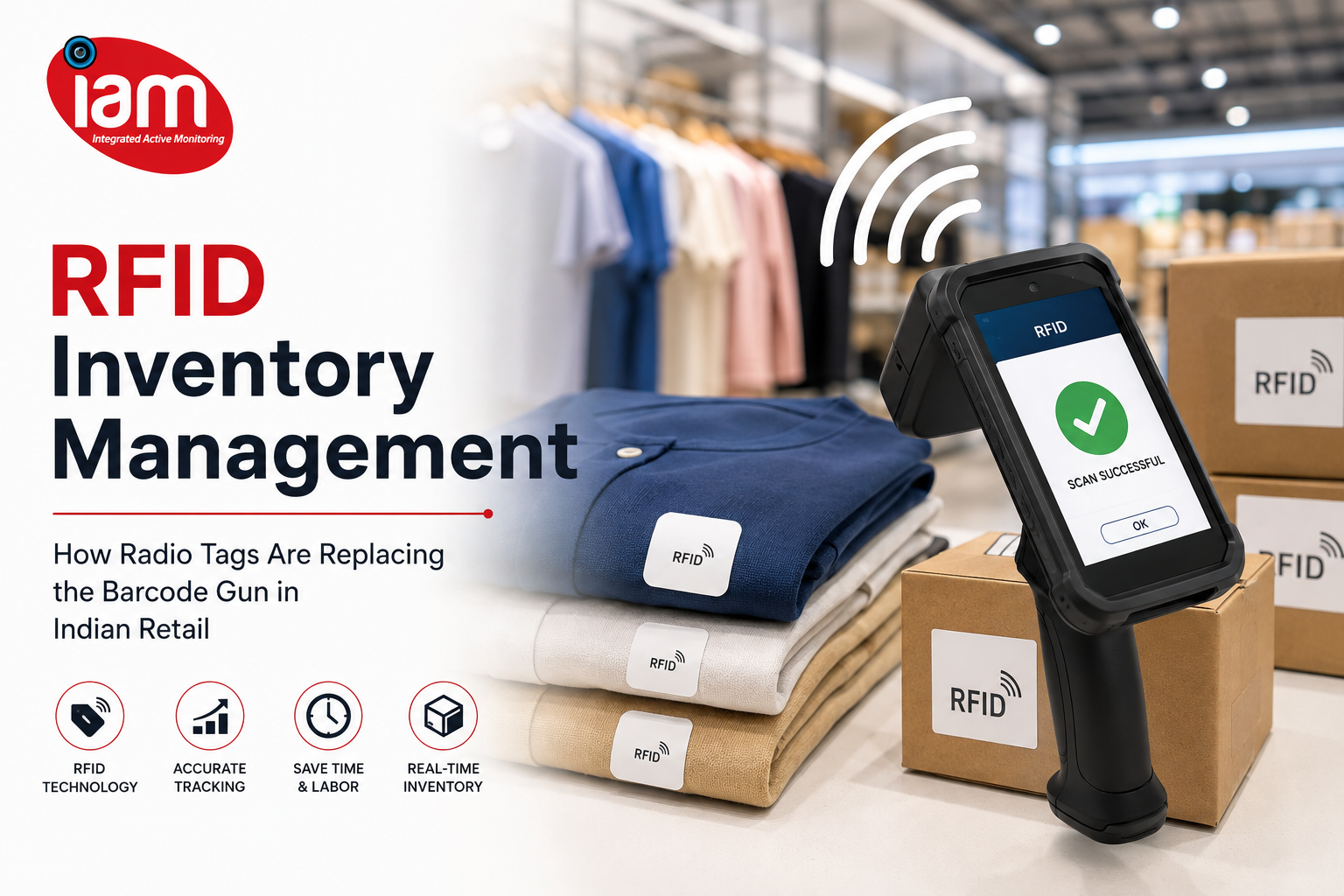
RFID stands for Radio-Frequency Identification: a wireless system that uses electromagnetic fields to read data from a tag attached to an item, without any physical contact or visual alignment. Unlike a barcode, which has to be scanned individually and visibly, an RFID reader can pick up dozens or hundreds of tags simultaneously, from a distance, even when the tagged items are stacked, boxed, or moving past on a conveyor. That’s the core mechanical difference behind every operational gain retailers report: faster counts, fewer misses, and inventory numbers that actually match what’s on the shelf. Smart IAM’s RFID solutions are built around exactly this gap between what a barcode can see and what a radio signal can.
How an RFID system actually works
Three components make up any RFID deployment: tags, readers, and a software layer that turns raw reads into usable data.
RFID tags and stickers carry a small chip and antenna, encoded with a unique identifier for each item. These get attached during manufacturing, at a distribution center, or on the shop floor, depending on how far upstream a retailer wants tracking to start.
RFID readers, handheld units for spot checks or fixed readers mounted at doorways, stockrooms, and checkout counters, broadcast a radio signal. Any tag within range responds automatically by transmitting its ID back, with no manual trigger needed.
The software layer takes those reads and turns them into something a store manager can act on: current stock counts by SKU, location-level visibility (is this jacket on the shelf or still in the stockroom?), and alerts when counts drift from expected levels. This is the same IoT backbone, sensors, wireless communication, and cloud software working together, that underpins most modern retail automation, not just RFID.
Retailers refer to this three-step flow as identify, capture, exchange: tag the item, scan it in bulk, and push the data into a cloud analytics platform where it becomes visible across the business, not just at the till.
Active, passive, and semi-passive tags: why the choice matters
Not all RFID tags work the same way, and picking the wrong type for the job is the most common reason a deployment underdelivers. There are three categories, and the differences come down to power source, range, and cost per tag.
Passive RFID tags have no internal battery. They draw power from the reader’s radio signal itself, which caps their range at roughly 10 cm to 15 meters depending on frequency, but keeps the per-tag cost down to single-digit rupees for high-volume runs. This is why passive tags dominate retail apparel, library systems, and access control, where item counts run high and cost per tag matters more than read range. Passive tags run across three frequency bands: low frequency (125-134 kHz), high frequency (13.56 MHz), and ultra-high frequency, or UHF (865-960 MHz), with UHF RFID now the standard choice for retail inventory because it reads faster and further than LF or HF.
Active RFID tags carry their own battery and broadcast continuously, giving them a read range up to 200 meters, but at a materially higher cost, often ₹500-3,000 per tag. That cost only makes sense for high-value, low-volume tracking: shipping containers, vehicles, industrial equipment, anything where losing track of the asset costs far more than the tag itself.
Semi-passive tags, also called battery-assisted passive (BAP) tags, sit in between. The battery powers the chip’s onboard sensors, but the tag still relies on a reader to transmit data, which extends range to 15-50 meters at a mid-range cost. This makes BAP tags the practical choice for cold chain and smart packaging applications, where a tag might also need to log temperature or humidity data, not just an ID number.
Getting this choice wrong is expensive in both directions: active tags on retail apparel burn budget on a read range the store doesn’t need, while passive tags on a fleet of delivery vehicles simply won’t hold a signal at the range the job requires.
RFID vs barcode: what actually changes on the floor
The comparison retailers actually care about isn’t a spec sheet. It’s what changes during a stock count. A barcode requires direct line of sight and one-at-a-time scanning; a folded shirt with the tag facing inward, or a box that hasn’t been opened, simply won’t scan. RFID doesn’t have that constraint. A handheld reader waved across a rack or a fixed reader at a stockroom door picks up every tagged item in range, whether it’s visible or not, in a fraction of the time.
The accuracy numbers reflect that gap directly. Manual and barcode-based counts typically land in the 65-75% accuracy range once a store has more than a few hundred SKUs, staff skip items, misplace stock between the shopfloor and stockroom, or simply run out of time before the count is done properly. RFID-based counts routinely reach 98-99% accuracy in the same environment, because the reader isn’t relying on a person to physically locate and scan every item.
That accuracy gap is where the financial case gets concrete. A mid-sized apparel chain running ten stores can lose ₹50-80 lakh a year to shrinkage alone, on top of markdown losses from overstocking items that inventory data said were scarce when they weren’t. Neither problem is really about theft or bad buying decisions, both trace back to inventory numbers the business couldn’t trust. Loss prevention against that kind of shrinkage is also where RFID overlaps with Smart IAM’s Crosspoint EAS antenna systems, which cover the same theft-detection ground at the store exit.
Where RFID inventory management earns its keep
Inventory accuracy and replenishment
This is the foundational use case: knowing what’s actually on the shelf versus what the system says is there. Real-time stock visibility lets a store trigger reorders automatically instead of waiting for a manual count to catch a gap, which directly cuts both stockouts and the overstock write-offs that eat into margin. Paired with electronic shelf labels, which keep the price on the shelf synced with the price in the system, RFID closes the loop between what’s in stock and what a customer sees on the tag.
Omnichannel fulfillment
Buy-online-pickup-in-store only works if the online system’s stock count matches the physical shelf, in real time. RFID is what makes a single store double as a fulfillment hub without constant stock discrepancies between channels. It also cuts down on return fraud, since item-level tracking makes it possible to verify that what’s coming back is actually what went out.
Faster supply chain movement
A reader can scan a full carton of stock in seconds without anyone opening the box, which matters most at receiving docks and distribution centers handling high SKU volumes during peak seasons. Diwali stock builds are a good example: the volume moving through a warehouse in a few weeks can dwarf the rest of the year combined. Smart IAM’s own warehouse monitoring work covers the same receiving-dock and stockroom visibility problem from the facilities side.
Loss prevention and shrinkage detection
Item-level tracking makes it possible to flag unusual movement patterns, stock disappearing from a specific zone, or moving between locations in ways that don’t match sales data, well before a physical audit would catch it.
Operational analytics –
Beyond counting stock, the same data answers questions retailers previously had no clean way to ask: which zones see the most shrinkage, how store-level stock movement compares to warehouse dispatch, and where reorder points need adjusting based on actual sell-through rather than last season’s assumptions. Retailers already using heat mapping and dwell time analytics to understand shopper behavior tend to layer RFID stock data on top of the same dashboard, since both feed the same store-performance picture.
Beyond retail: where else RFID is doing real work
Retail gets most of the attention, but RFID’s use cases extend well past inventory counts. Transportation runs on it already: FASTag, India’s electronic toll collection system, is passive RFID at national scale, reading vehicle tags at highway speed without requiring a car to stop. Healthcare facilities use RFID for both asset tracking (locating equipment across a hospital in real time) and patient tracking in high-acuity wards. Pharmaceutical manufacturers face a more specific driver: CDSCO traceability mandates now require serialized tagging on export shipments, which is pushing RFID adoption across domestic formulation facilities that supply regulated markets, not just the ones selling internationally.
Manufacturing environments use RFID differently than warehouses do. The focus shifts from simple stock counts to tracking material consumption and maintaining identity continuity for partially assembled products as they move through production. Mining and heavy industry lean on RFID mainly for safety and asset visibility, tracking equipment and personnel across large, often hazardous sites where manual checks are slow and sometimes risky.
What to check before choosing an RFID solution
The technology decisions that matter aren’t the flashy ones. Before signing off on a deployment, it’s worth pinning down which frequency band fits the read range the operation actually needs (UHF for most retail and warehouse use, LF or HF for close-range applications like access control), whether tags get applied at the source during manufacturing or added later in the supply chain, what the reader infrastructure costs to install across every doorway and checkout point that needs coverage, and whether the software layer integrates cleanly with the existing point-of-sale and inventory systems instead of running as a disconnected add-on.
A retailer that gets these decisions right typically sees measurable results within the first full inventory cycle. Accuracy gains show up almost immediately, since the technology either reads a tag correctly or it doesn’t. The slower payoff is in the analytics layer: shrinkage patterns, reorder timing, and cross-store comparisons that take a few sales cycles to become genuinely useful, once there’s enough real data behind them to spot the patterns rather than guess at them. Smart IAM’s Style Union deployment is a working example of what that multi-store visibility looks like once the data starts compounding across locations, and the broader case for treating RFID as part of a wider automation stack rather than a standalone fix is laid out in Ten Reasons to Choose Smart IAM for Retail Automation.
FAQ’s
1. What is RFID in inventory management?
RFID (Radio-Frequency Identification) is a wireless technology that uses electromagnetic fields to read data stored on tags attached to items. In inventory management, RFID enables businesses to identify and track multiple items without requiring direct line-of-sight scanning.
2. How is RFID different from a barcode?
RFID can read multiple tagged items simultaneously and does not generally require the direct line of sight needed by traditional barcode scanning. This can make inventory counting and stock tracking faster and more automated.
3.What are the main types of RFID tags?
The main types are passive, active, and semi-passive RFID tags. Passive tags obtain energy from the RFID reader, active tags contain their own power source, and semi-passive tags use a battery to power the tag’s internal functions while relying on the reader for communication.
4.How can RFID improve retail inventory accuracy?
RFID can provide more frequent and automated visibility into item-level inventory, helping retailers identify stock discrepancies, improve replenishment, reduce manual counting, and maintain more accurate inventory records.
5.Can RFID be used for omnichannel retail fulfillment?
Yes. RFID inventory visibility can help retailers determine where products are available across stores, stockrooms, and distribution locations, supporting processes such as ship-from-store, click-and-collect, and other omnichannel fulfillment models.
6.What should retailers consider before choosing an RFID inventory management solution?
Retailers should consider factors such as RFID tag type, reader range and placement, operating environment, integration with existing POS or inventory systems, scalability, data accuracy, implementation requirements, and the specific inventory-management objectives of the business.