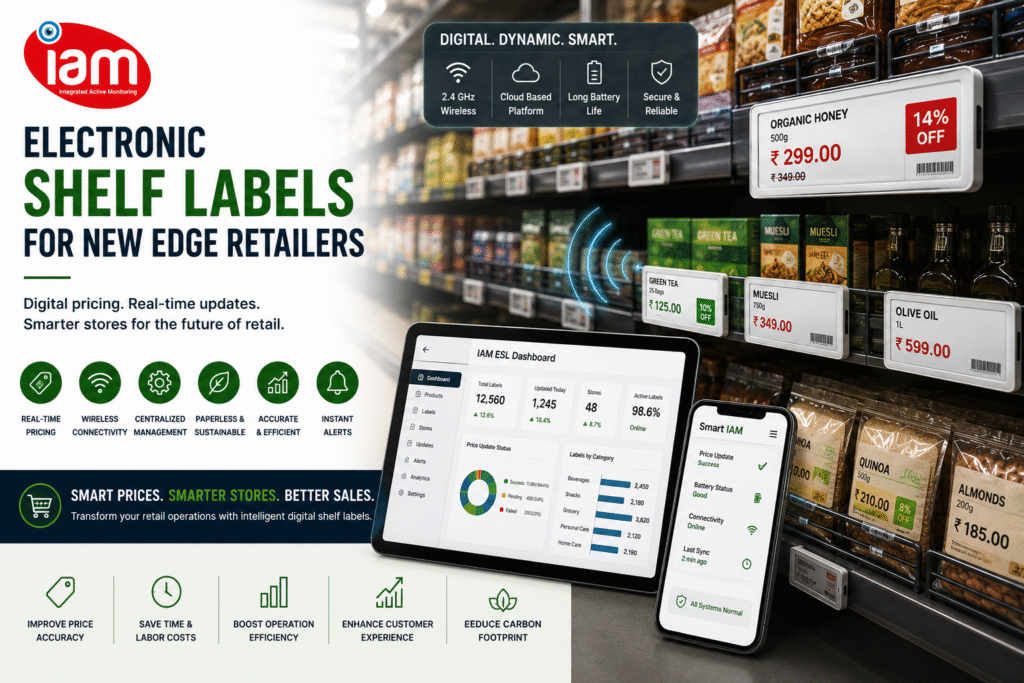
Walk any customer down a retail aisle and watch where their eyes go. Not the packaging, not the branding — the price tag. Shoppers weigh variants, compare features, and talk themselves through the trade-offs, but the number on the shelf edge is where the decision is made. Which means the moment that number is wrong — a stale promotion, a tag that never got updated, a rate the staff mis-keyed — you don’t just lose a sale. You lose trust, and trust is the one thing a modern retailer can’t reprint on a paper slip.
That fragile little paper label is quietly one of the biggest liabilities in a store. Electronic Shelf Labels (ESLs) exist to remove it.
The hidden cost of a paper price tag
Paper labels look cheap because the paper is cheap. The real cost is everything around them.
Every price change means a staff member printing tags, walking the aisles, and swapping them by hand — sometimes several times a day in a fast-moving store. That’s labour spent on a task that adds nothing to the customer experience. Worse, it’s labour that introduces error: a tag missed on a back shelf, a promotion that ended but never came down, a decimal typed wrong. The customer reaches the till, the price doesn’t match, and now you’re managing a dispute instead of a sale.
For a new-edge retailer competing against e-commerce — where prices update instantly and the “right” price is always live — a store running on paper is fighting with one hand tied. You simply cannot react to a competitor’s price drop at the speed the market now demands when your pricing lives on printed cardstock.
What Electronic Shelf Labels actually do
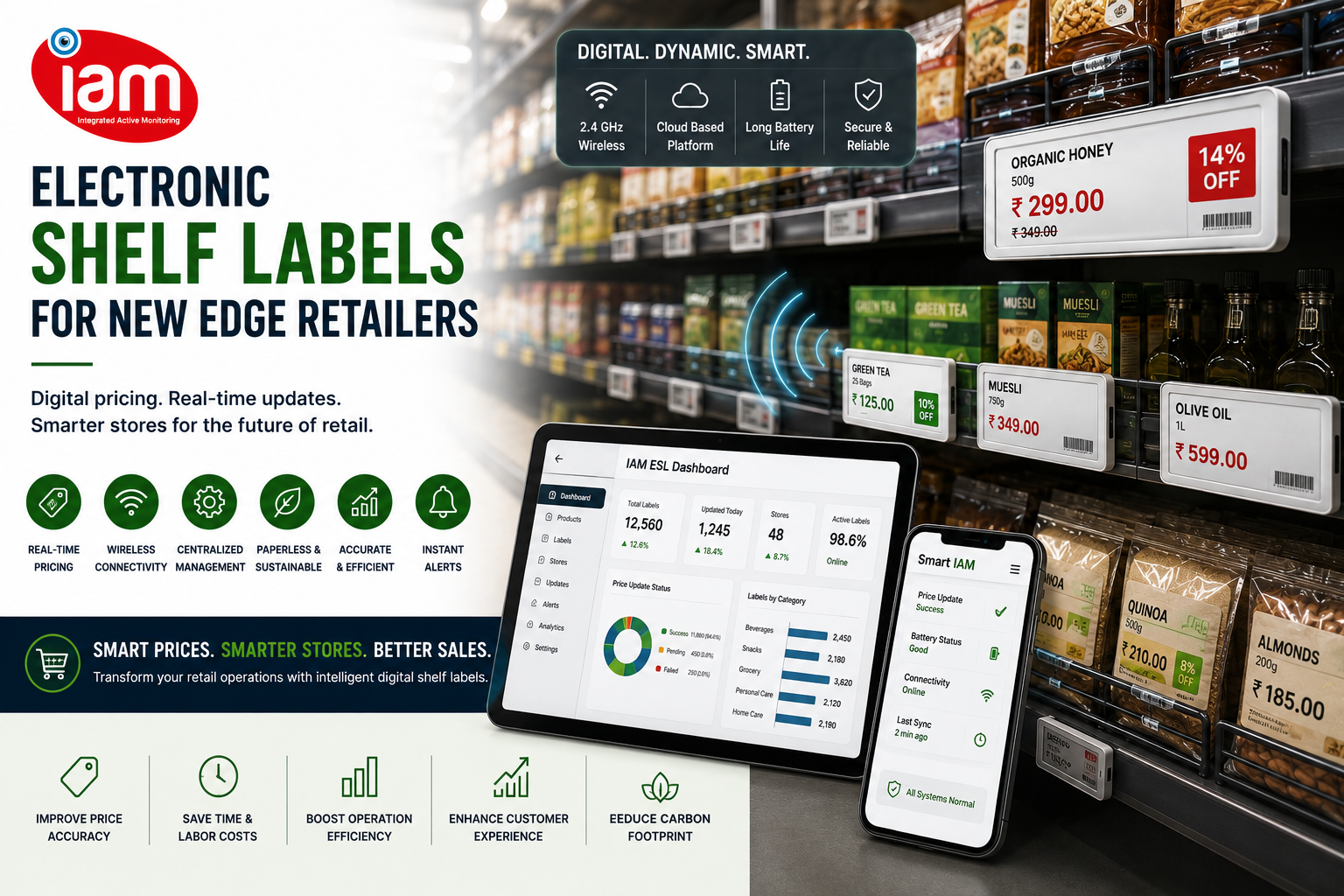
An Electronic Shelf Label is a small digital display — usually e-ink, the same paper-like technology as an e-reader — mounted on the shelf edge in place of a paper tag. Every label connects wirelessly to a central control system. Change a price once, at the server, and it pushes instantly and accurately to every relevant label across the shelf, the store, or an entire chain.
The Electronic Shelf Labels system offered by Smart IAM is built for exactly this. Enterprise-grade ESLs use high-contrast E-Ink displays that stay crisp and readable under any retail lighting, hold their image without drawing constant power, and update in seconds over secure wireless connectivity. Because the display only consumes energy when it changes, a single label runs for years on its battery.
The immediate wins are simple: pricing errors drop to near zero, the hours your staff spent swapping tags come back, and the price on the shelf always matches the price at the till. But the strategic value goes further.
Why “new-edge” retailers are moving to ESL
The retailers adopting ESL fastest aren’t doing it just to save on tag-printing. They’re doing it because digital labels unlock things paper never could.
Dynamic pricing. When your prices live in software, you can move them the way an online store does — responding to demand, competitor rates, or time of day. A price-match to an online competitor that used to take a day of aisle-walking now takes one entry at the server.
Zero-friction promotions. Launching a weekend offer or a flash discount is a single action, reflected across every store at once and reversed just as fast when it ends. No printing, no manual rollback, no forgotten tags advertising a promotion that closed on Sunday.
Perishable and expiry management. For grocery and fresh-food retailers, ESLs make “last-day” discounting instant. Mark nearing-expiry stock down the moment it makes sense, sell it before it’s waste, and protect margin that would otherwise hit the bin.
Omnichannel consistency. The price a customer sees online and the price they see in the aisle finally agree, because both are driven from the same source. In an era where shoppers price-check on their phone while standing in your store, that consistency is what keeps them buying from you.
ESL as part of a smarter store, not a standalone gadget
ESL rarely arrives alone. Retailers investing in digital pricing are usually rethinking the whole store as a connected system — and that’s where the technology earns its keep.
Price data pairs naturally with the rest of a modern retail stack: RFID solutions for real-time inventory so a label can flag out-of-stock, people counting and heat-mapping analytics to understand which aisles and price points actually convert, and digital signage to carry that same live, centrally-managed messaging from the shelf edge to the store front. Together they turn a static shop floor into something that responds — the core idea behind the retail security and automation approach at Smart IAM.
If you want the ground-level mechanics of how the technology works, the deeper explainer on going smart with Electronic Shelf Labels covers the components and workflow. And for retailers weighing a broader upgrade, the case for retail automation as a whole puts ESL in context alongside the other systems a competitive store now runs.
The shelf edge is your last impression before the sale
Every purchase decision passes through the price on the shelf. Leaving that critical touchpoint to paper — slow to change, easy to get wrong, invisible to your systems — is a gap a new-edge retailer can’t afford. Electronic Shelf Labels close it: accurate every time, updated in seconds, and wired into the same intelligence running the rest of your store.
Paper told your customer a price. ESL tells them the right price, right now — and frees your team to do the work that actually grows the business.
Ready to digitise your shelf edge? Talk to Smart IAM about Electronic Shelf Labels for your stores.