What Is an Energy Monitoring System? A Business Guide to Cutting Power Costs
Energy is the quiet line item that runs every business. Electricity, water, fuel, solar — it powers the buildings, the plants, the hotels, the campuses, and the stores, and for most operations it’s simply assumed rather than examined. Then the bill arrives. Over the last decade, as tariffs have climbed to new highs, that assumption has become an expensive one, and the pressure to bring energy spending back into line with earnings is now a boardroom conversation, not a facilities one.
There’s a second pressure sitting right alongside the first. Every unit of energy burned carelessly is also carbon, and businesses are increasingly answerable for the footprint they leave. Cutting waste is no longer just about the money — it’s about sustainability, compliance, and reputation, all at once.
The problem is that a monthly electricity bill tells you almost nothing. It shows a single number — units consumed — at the end of the month, long after you could have done anything about it. It doesn’t tell you what consumed the power, when it spiked, or where it was wasted. That’s the gap an energy monitoring system fills.
What an energy monitoring system actually is
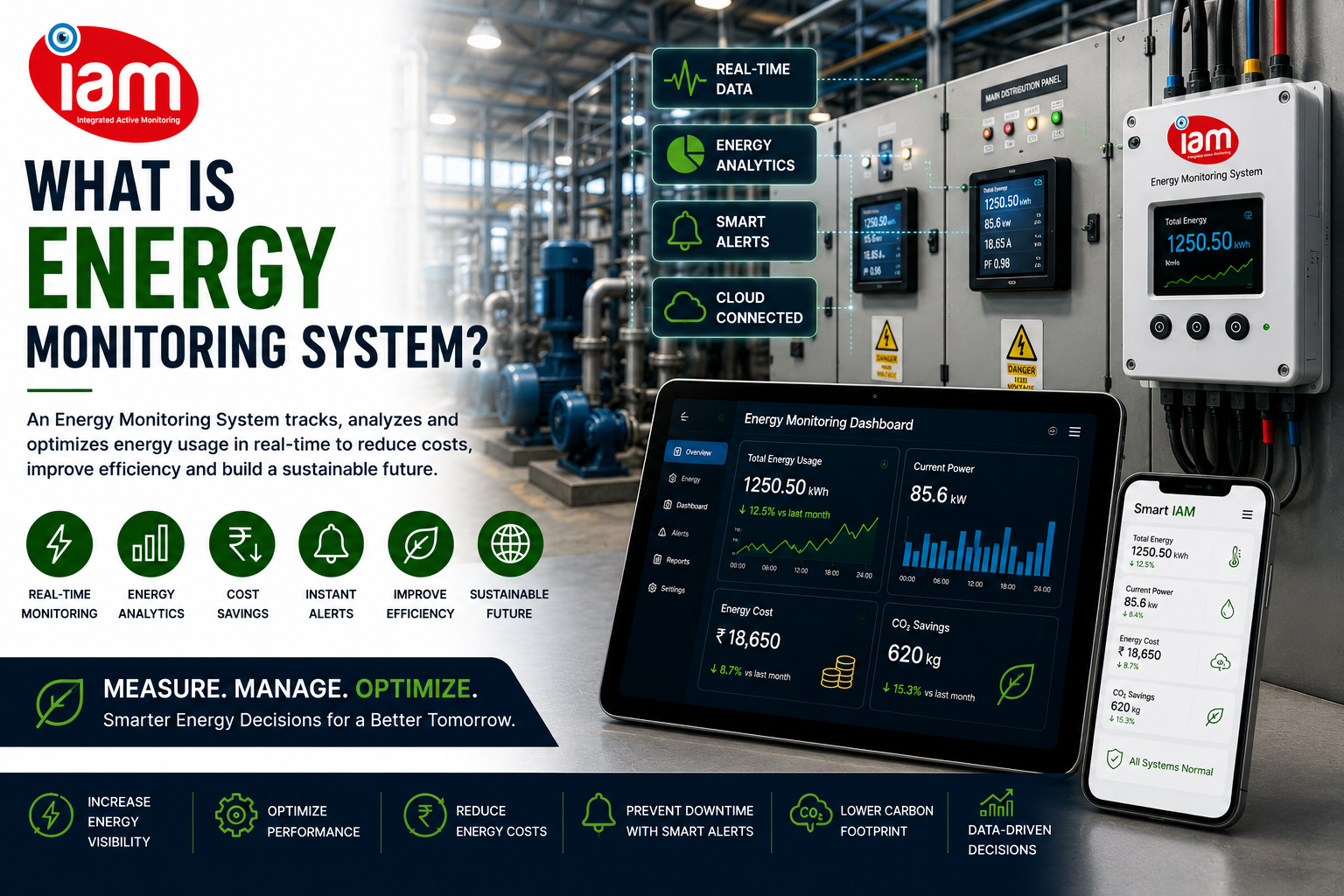
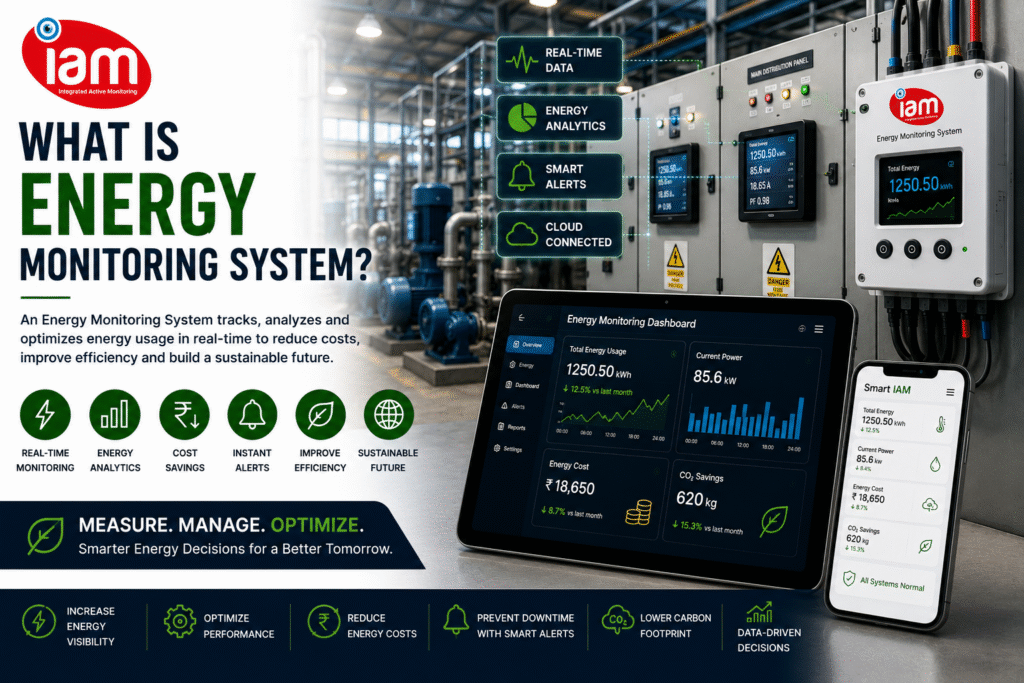
An energy monitoring system is a technology setup that measures your energy consumption continuously and in real time, then turns that raw usage into information you can act on.
Instead of one number a month, it gives you a live, detailed picture: how much power each device, zone, or location is drawing, at any given moment. Energy meters and sensors sit across your premises capturing consumption, the data flows over a wired or wireless network to a central server or cloud dashboard, and authorised people can view it from a phone or laptop wherever they are. What was once an invisible, after-the-fact expense becomes a visible, measurable, controllable operation.
The Energy Monitoring System from Smart IAM is built on exactly this principle — an IoT-based platform giving 24/7 real-time visibility into power consumption, energy inefficiencies, and device-level usage across every business location, then generating the insights that turn that visibility into savings.
From “how much” to “why” — the shift that saves money
The real value of energy monitoring isn’t measurement. It’s understanding.
Knowing you used a certain number of units is trivia. Knowing that a particular air-conditioning unit runs at full load after hours when the building is empty, that a specific machine draws abnormally high current because it’s overdue for maintenance, or that one branch consistently consumes far more than an identical one — that is where money is found. Energy monitoring covers the full arc: managing how resources are used, eliminating unnecessary wastage, and detecting the hidden inefficiencies that quietly inflate every bill.
A few of the things continuous monitoring surfaces:
- Device-level consumption — you see exactly how much each asset or zone draws, so the biggest consumers stop hiding inside a single monthly total.
- Spikes and irregularities — sudden jumps often mean a fault, misuse, or in some cases power theft, all of which you can catch in the moment rather than in hindsight.
- Underperforming equipment — appliances that have drifted out of tune consume far more than they should, and monitoring makes that drift obvious before it becomes a large recurring cost.
- Waste patterns — lighting, cooling, and systems left running outside operating hours become visible, and therefore fixable.
Why it matters more now than ever
Two forces make energy monitoring a priority rather than a nice-to-have.
The first is cost. With tariffs high and rising, energy is often one of the largest controllable operating expenses a business has — and unlike rent or salaries, it’s full of waste that can be removed without cutting anything that matters. Trimming even a modest percentage off consumption flows straight to the bottom line, year after year.
The second is sustainability. Reducing energy use directly reduces carbon footprint, which increasingly feeds into regulatory compliance, ESG reporting, and how customers and partners judge a business. Monitoring gives you the hard data to prove those reductions, not just claim them. For any operation serious about a more energy-efficient future, measurement is the necessary first step — you cannot improve what you cannot see.
Where energy monitoring fits in a connected operation
Energy rarely sits alone. The same infrastructure that watches your power usually watches the conditions around it, because the two are deeply linked — cooling, ventilation, and equipment health all drive consumption.
This is why energy monitoring pairs naturally with environmental monitoring, which tracks temperature, humidity, and air quality across sensitive spaces like cold storage, data centres, and warehouses on the same real-time dashboard. Both feed into a single centralized monitoring system, so power, environment, security, and safety are watched from one command view rather than a scatter of disconnected tools. For energy-intensive operations, the manufacturing-focused guide to efficient ways to save energy shows how these insights translate into concrete action on the plant floor.
That integration is the whole idea behind the Smart IAM approach — not a single gadget, but a connected system that turns scattered operational data into decisions.
From an unexamined bill to a managed cost
An energy monitoring system takes the most passive expense in your business — a number you receive and pay — and makes it active. You see where every unit goes, catch waste and faults as they happen, and turn a monthly surprise into a cost you actively manage down, month after month.
Lower bills and a smaller carbon footprint aren’t a trade-off. With the right visibility, they’re the same decision.
Want to see where your energy actually goes? Talk to Smart IAM about an Energy Monitoring System for your business.