Occupancy Monitoring for Retail Stores and Supermarkets
Every retailer tracks how many people came in today. Far fewer can tell you how many are inside right now — and that second number is the one that actually governs how a store performs hour to hour.
It determines whether your aisles feel comfortable or claustrophobic, whether your checkout queues are about to spiral, whether your staff are positioned where the customers are, and whether you’re heating and lighting a floor that’s half empty. Occupancy monitoring is what turns that live number from a guess into an instrument.
Occupancy is not footfall — and the difference matters
These two terms get used interchangeably, and they measure genuinely different things.
Footfall is cumulative: the total number of people who entered over a period. It answers “how busy were we today?” and it’s the foundation of conversion rate and marketing measurement.
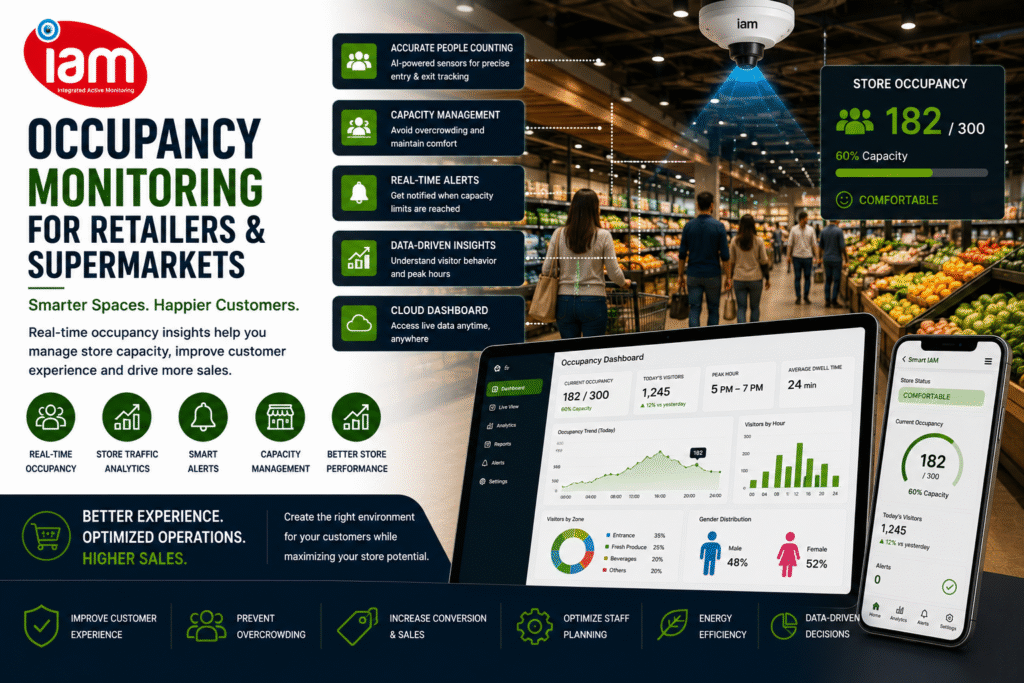
Occupancy is a live count: entries minus exits, right now. It answers “how many people are in the building at this moment?”
A store might record 1,800 visitors across a day — strong footfall — while its occupancy peaked at 90 people for twenty minutes at 6:40pm and sat under 15 for most of the morning. Footfall tells you the day was good. Occupancy tells you exactly when the store was under strain, which is the number you act on in real time.
Both come from the same sensors. Bi-directional counting at every entry and exit captures the in-and-out flow, and the software derives cumulative footfall and live occupancy from the same data stream. You don’t choose between them — you get both, and each answers a different class of question.
Why supermarkets and retail stores need the live number
Crowd comfort and capacity. Shoppers abandon crowded stores. When aisles are congested and queues are long, people put the basket down and leave — a lost sale that never appears in any report because it never became a transaction. Real-time occupancy lets you see density building before it costs you, and act on it.
Staffing that responds to now, not to a schedule. Historical footfall tells you Saturdays are busy. Live occupancy tells you this Saturday is unusually busy at 4pm and you need two more tills open immediately. It’s the difference between planning for demand and responding to it.
Queue and checkout management. Occupancy rising sharply while transaction rate stays flat is an early warning that people are stacking up at the front of the store. Catching that ten minutes earlier is often the entire difference between a smooth rush and a bad customer experience.
Safety and compliance. Maximum-occupancy limits exist for fire and safety reasons, and enforcing them by eye is unreliable. Automated counting gives you an auditable record that you operated within capacity — useful for compliance and for insurance.
Energy that follows people. This is the benefit most retailers overlook. Cooling and lighting a full store and an empty one cost the same if nothing is measuring the difference. Feeding occupancy data into building systems means HVAC and lighting respond to actual presence — a direct link between people-counting and energy monitoring, and one of the fastest ways to cut what is typically a retailer’s largest controllable overhead. The data behind commercial energy consumption makes clear why matching load to occupancy pays back quickly.
How the technology works
Occupancy monitoring is a practical application of IoT: inexpensive sensors, ubiquitous wireless connectivity, and cloud software combining to report physical activity as live data without anyone counting anything manually.
Sensors mounted at entry and exit points capture movement in both directions. That data flows continuously to a dashboard where managers see current occupancy, peak periods, and historical patterns across one store or an entire chain. The AI-powered people counting platform behind Smart IAM’s deployments delivers exactly this — real-time counts, demographic insight, and trend history for retail stores, malls, supermarkets, and smart buildings.
Accuracy is what changed the game. Early sensors were too unreliable to base decisions on; modern systems are precise enough that the count can drive staffing, safety limits, and building automation. Crucially, they count people without identifying them, so you gain the operational insight without collecting personal data.
From counting to understanding
Live occupancy is the starting point, not the destination. Once you know how many people are inside, the natural next questions are where they go and how long they stay — which is where heat mapping, dwell time, and demographic analytics extend a headcount into a full behavioural map of the store. Together they show not just that the store was busy, but which zones drew people, which were ignored, and where customers hesitated.
That combined picture is what makes the rest of a modern store worth building — pricing, layout, staffing, and retail automation all improve when they’re informed by real occupancy data rather than assumption. And because occupancy feeds the same centralized monitoring system as your security, energy, and environmental data, it becomes one input into a single operational view rather than another isolated dashboard.
The number worth watching
Retail has always measured what it sells. Occupancy monitoring measures the conditions under which selling happens — how crowded, how comfortable, how well-staffed, how efficiently powered. Those conditions determine whether the visitors you worked so hard to attract actually convert, or quietly walk back out.
You already know how many came in. It’s worth knowing how many are in there right now.
Want live occupancy data for your stores? Talk to Smart IAM about occupancy monitoring and people counting.